



































































































































































Can Exercise Lift Sagging Breasts? 8 Exercises to Try
Author: RVLNSV PRASAD
Updated: September 2026
About Us | Author Biography | Editorial Policy | Contact Us
Author Note
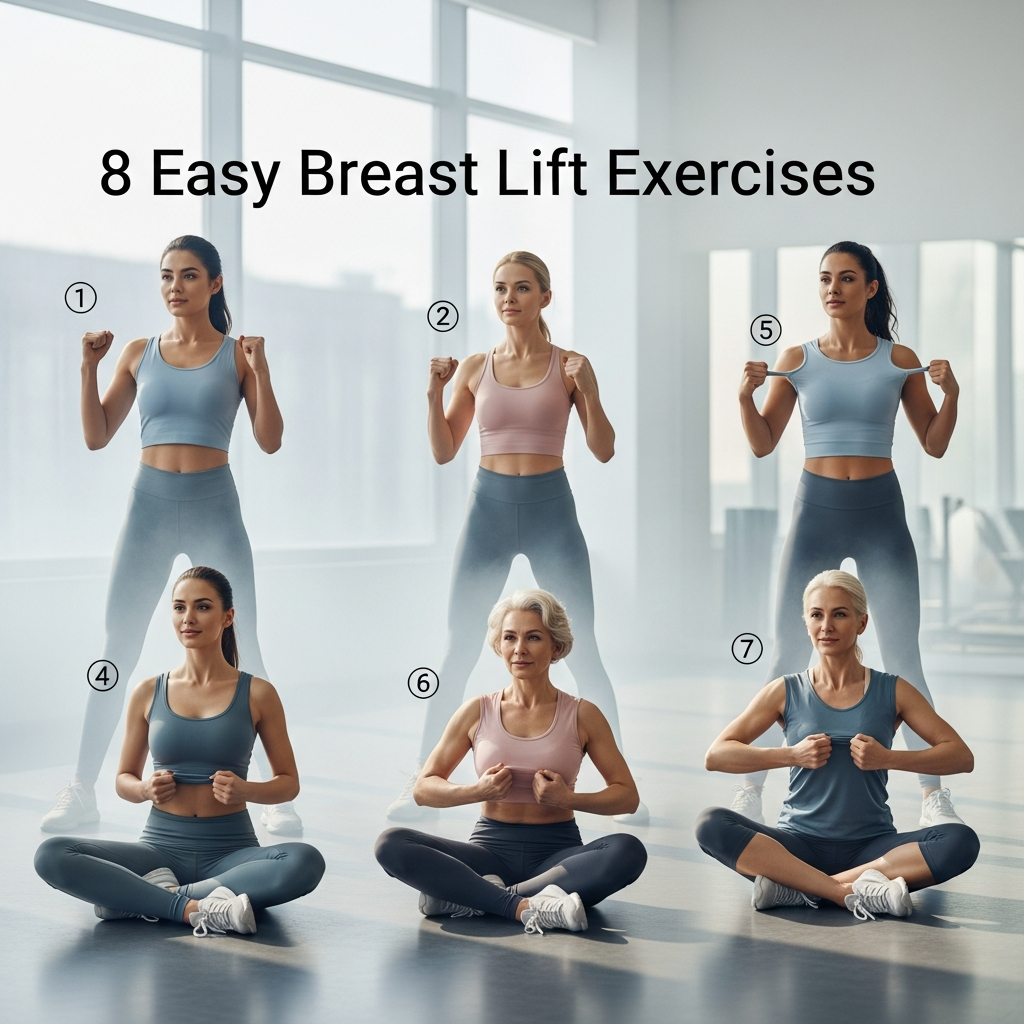
One thing I think readers deserve from fitness content is an honest explanation of what an exercise can actually change.
The phrase “breast lift exercises” can create the impression that a particular movement can physically raise breast tissue. That is not how the body works. The breasts are not muscles, while the pectoral muscles sit underneath them. Strength training can develop those underlying muscles and improve upper-body strength and posture, but it cannot surgically reposition breast tissue or remove excess skin.
That distinction is especially important when someone has experienced pregnancy, major weight changes, or age-related changes in breast shape. Mayo Clinic explains that breast changes can be associated with aging, pregnancy, weight changes, and gravity, while an actual breast lift reshapes breast tissue and removes excess skin to raise the breasts. Mayo Clinic—Breast Lift
This article therefore takes a different approach. Rather than promising a dramatic “natural lift,” it explains what chest and upper-body exercises can realistically do, how to perform them, what results may be noticeable, and when a breast-health concern should be evaluated by a healthcare professional.
Introduction
Can exercise lift sagging breasts? It is a common question, especially for women who notice changes in breast shape after aging, pregnancy, breastfeeding, weight changes, or simply over time. The short answer is that exercise cannot physically lift breast tissue in the same way as a surgical breast lift, but targeted exercises can strengthen the chest and upper-body muscles underneath the breasts, improve posture, and potentially make the chest area look more supported and defined.
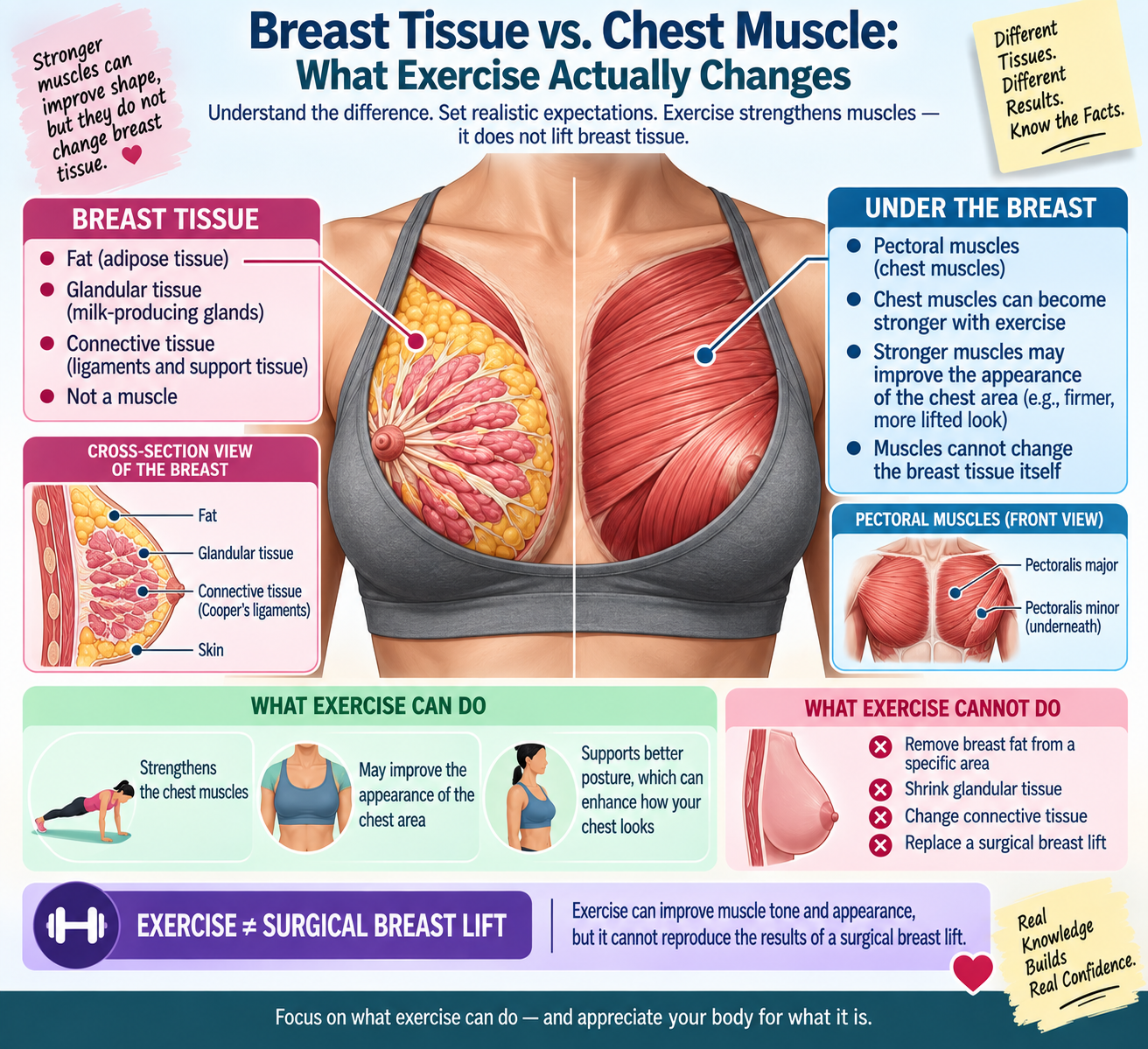
This distinction matters because breasts are made primarily of glandular, connective, and fatty tissue rather than muscle. The chest muscles lie underneath the breast tissue. Therefore, strengthening those muscles does not directly tighten or reposition the breast tissue itself. A medical breast lift, known as mastopexy, physically reshapes and raises the breasts by removing excess skin and tightening surrounding tissue.
However, that does not mean chest exercises are pointless. Exercises such as modified push-ups, chest presses, chest fly movements, and certain posture-focused exercises can strengthen the pectoral and supporting muscles. Mayo Clinic, for example, identifies push-ups as an exercise that works the pectoral muscles, while chest presses specifically target the chest.
The goal of this guide is therefore not to promise a “natural breast lift” or suggest that one exercise can reverse sagging. Instead, it explains what exercise can realistically change, what it cannot change, which exercises are worth trying, and how to build a sensible routine without unrealistic expectations.
Quick Answer: Can Exercise Lift Sagging Breasts?
No exercise can physically lift sagging breast tissue in the same way as a surgical breast lift.
However, exercise may improve the appearance of the chest in some people.
Chest-strengthening movements can develop the pectoral muscles underneath the breasts. Upper-back exercises can help build the muscles involved in maintaining posture. A stronger upper body may therefore make the chest appear more supported or defined.
But there is an important difference between changing the muscular foundation underneath the breast and changing the breast tissue itself.
A surgical breast lift, or mastopexy, raises the breasts by removing excess skin and tightening or reshaping surrounding tissue. American Society of Plastic Surgeons — Breast Lift
So, if you are searching for exercises for sagging breasts, think of the goal as improving chest strength, posture, and overall upper-body fitness—not physically lifting the breast tissue.
Key Takeaways
- Exercise strengthens muscles; breasts themselves are not muscles.
- Chest exercises can develop the pectoral muscles underneath the breasts.
- Upper-back and shoulder exercises can support better posture.
- Better posture may change how the chest looks when standing.
- Exercise cannot remove excess breast skin.
- Exercise cannot reposition the nipple.
- Exercise cannot guarantee a permanent breast lift.
- Pregnancy, weight changes, aging, gravity, and heredity can all influence breast shape. Mayo Clinic — Breast Lift
- A supportive sports bra can improve exercise comfort, particularly during higher-impact activities.
- A new breast lump, nipple discharge, skin change, or unexplained breast change should be medically evaluated rather than treated as a fitness issue.
Why the Word “Lift” Can Be Misleading
When someone says, “I want to lift my breasts,” they may actually mean several different things.
They might want:
- A stronger chest
- Better posture
- More visible pectoral muscles
- A firmer-looking upper body
- Better support during exercise
- A change in the appearance of the chest
- Less noticeable slouching
- An actual change in breast position
These goals should not be treated as though they are the same.
The pectoral muscles lie beneath the breast tissue. Strength training can make those muscles stronger, but the workout does not turn breast tissue into muscle.
That is why a person can become noticeably stronger and improve their posture without experiencing a true anatomical breast lift.
A surgical breast lift is different. According to Mayo Clinic, mastopexy involves removing excess skin and reshaping breast tissue to raise the breasts and nipples. Mayo Clinic—What Is a Breast Lift?
The American Society of Plastic Surgeons similarly describes a breast lift as a procedure that removes excess skin and tightens surrounding tissue to reshape the breast contour. American Society of Plastic Surgeons—What Is a Breast Lift?
That distinction should be clear before starting any exercise program.
What Can Cause Breasts to Become More Saggy?
Breast shape naturally changes throughout life.
Aging can reduce skin elasticity. Pregnancy can increase breast volume and stretch supporting tissues. Weight fluctuations can stretch the skin, while gravity and inherited characteristics also influence breast shape.
Mayo Clinic identifies pregnancy, weight changes, and gravity among the factors associated with breast sagging and loss of firmness. Mayo Clinic — Breast Lift Causes and Changes
The American Society of Plastic Surgeons also lists pregnancy, breastfeeding, weight fluctuations, aging, gravity, and heredity among factors associated with changes in breast shape and firmness. American Society of Plastic Surgeons — Breast Lift
This is why it would be misleading to tell someone that a few weeks of chest exercises can reverse every form of breast sagging.
Some changes are muscular.
Others are related to skin, connective tissue, breast volume, and anatomy.
Exercise Changes the Foundation, Not the Breast Tissue
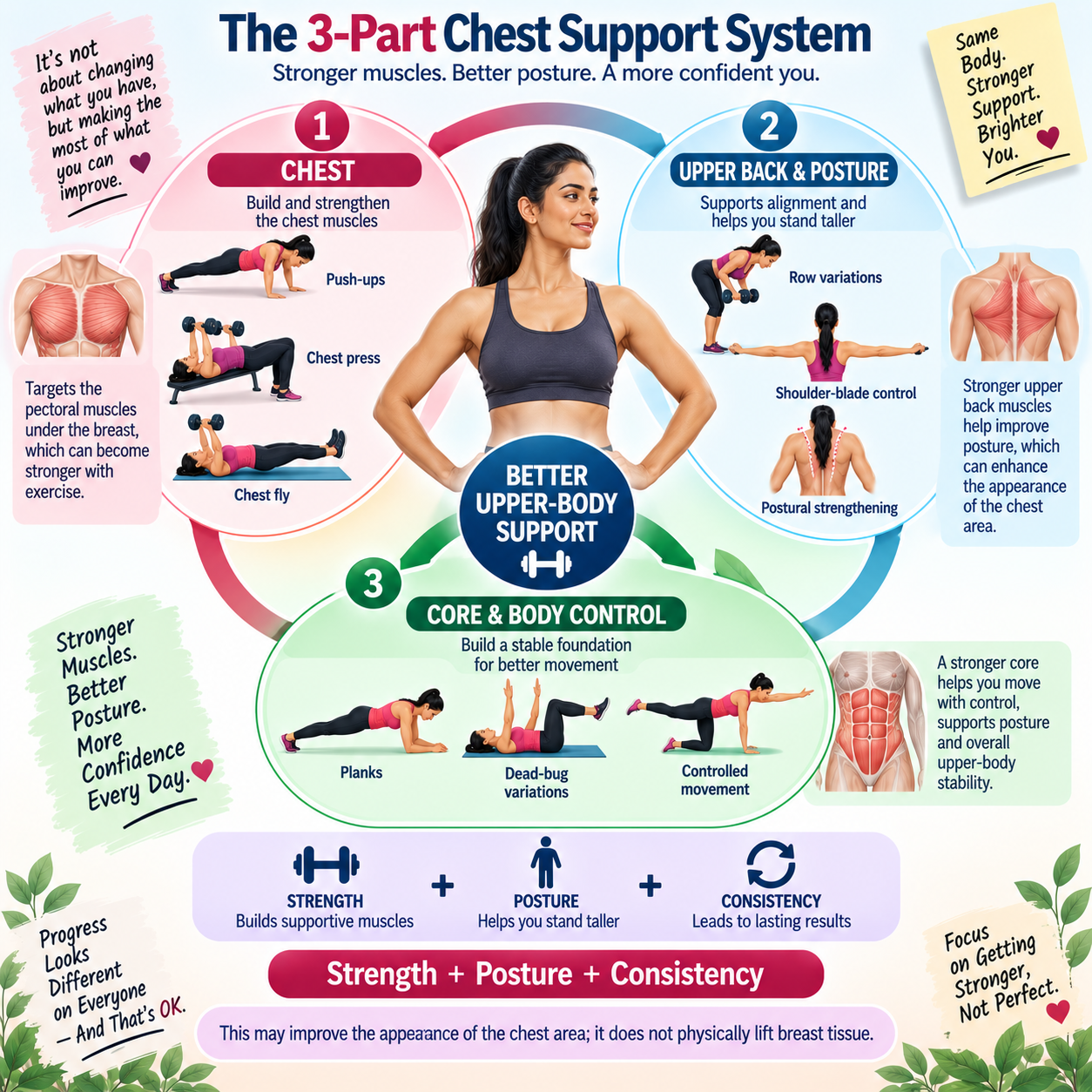
A useful way to understand this is to separate the chest into three areas.
Chest
The pectoral muscles are involved in pushing movements such as push-ups and chest presses.
Upper back
The muscles of the upper back help with shoulder and trunk positioning.
Core
Core strength helps provide stability during many upper-body exercises.
A balanced workout can train all three areas.
That is more sensible than performing eight nearly identical chest exercises simply because an article promises a “breast lift.”
The goal is to build a stronger body around the chest while keeping expectations realistic.
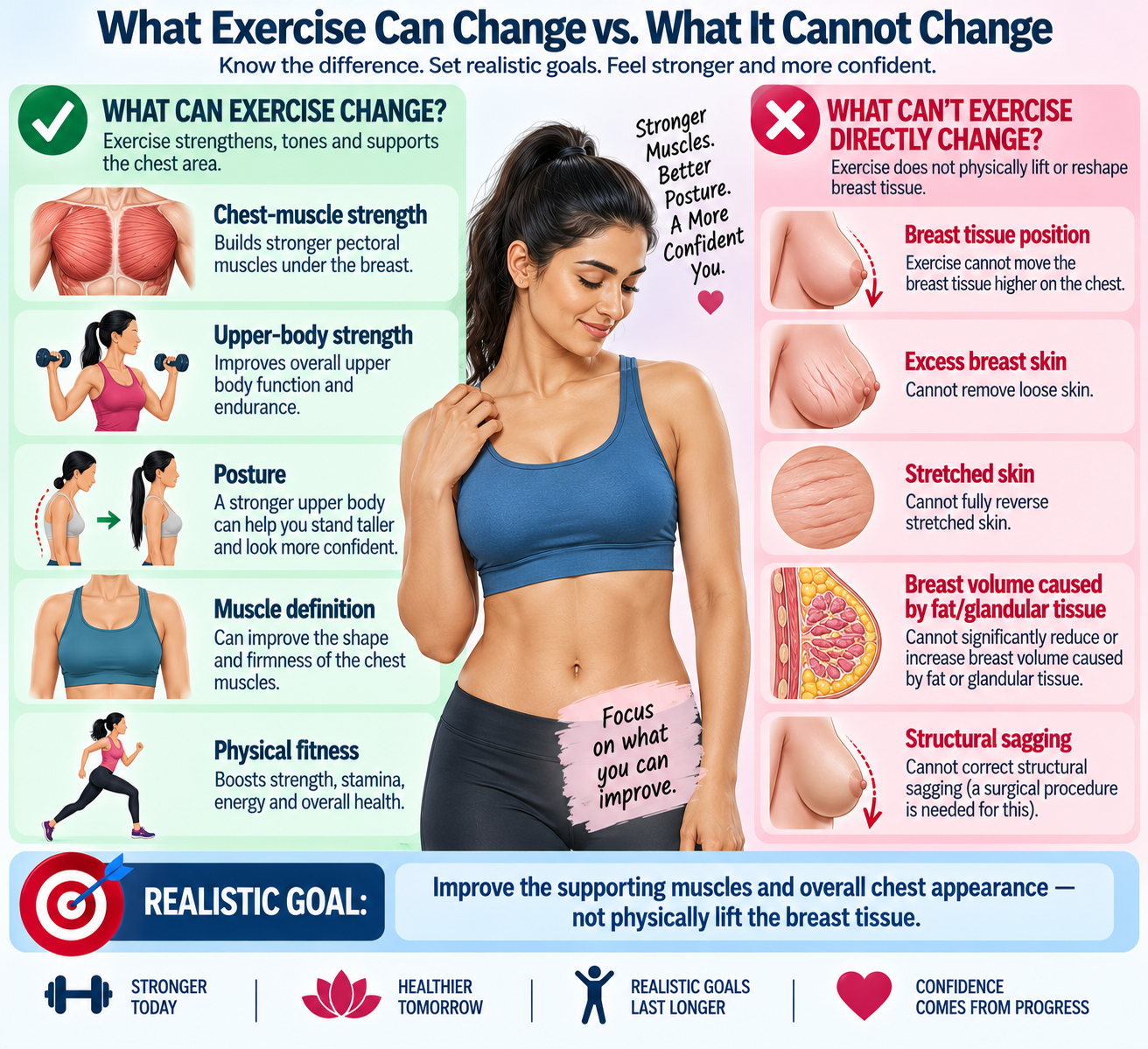
What Exercise Can Change—and What It Cannot
| Exercise may help with | Exercise cannot directly do |
|---|---|
| Pectoral muscle strength | Physically raise breast tissue |
| Upper-body strength | Remove excess breast skin. |
| Shoulder strength | Reposition the nipple. |
| Upper-back strength | Tighten stretched breast skin. |
| Posture | Recreate a surgical breast lift. |
| Muscle definition | Guarantee a particular breast shape |
| General physical fitness | Reverse every effect of aging. |
| Exercise confidence. | Permanently prevent future sagging |
This is one of the most important distinctions in this article.
If the problem is primarily muscular, exercise can help. If the concern is excess skin or breast-tissue position, exercise has limitations.
8 Exercises That May Improve Chest Strength and Appearance
1. Wall Push-Ups
Wall push-ups are an accessible starting point for beginners.
They reduce the amount of body weight being moved compared with a floor push-up, which can make the movement easier to learn.
How to do them
- Stand facing a sturdy wall.
- Place your palms against the wall around chest height.
- Step your feet backward.
- Keep your body in a comfortable straight position.
- Bend your elbows and bring your chest toward the wall.
- Push away from the wall.
- Repeat slowly.
Start with 8–15 repetitions for 2 sets.
As the exercise becomes easier, you can progress to an incline push-up using a stable elevated surface.
Push-up variations train the pectoral muscles along with other upper-body muscles. Mayo Clinic’s modified push-up guidance identifies the pectoral muscles among the muscles worked by the movement.
2. Incline Push-Ups
Incline push-ups provide a useful progression between wall push-ups and floor push-ups.
Use a sturdy surface that will not move.
How to do them
- Place your hands slightly wider than shoulder width.
- Walk your feet backward.
- Keep your body aligned.
- Bend your elbows.
- Lower your chest toward the surface.
- Push yourself back up.
- Keep the movement controlled.
Try 6–12 repetitions for 2–3 sets.
When the movement becomes comfortable, use a lower surface.
This gives you a simple progression without needing to immediately perform standard floor push-ups.
3. Dumbbell Chest Press
The dumbbell chest press directly trains the chest muscles.
How to do it
- Lie on your back on a stable bench or suitable exercise surface.
- Hold a light dumbbell in each hand.
- Position the weights over your chest.
- Lower them slowly.
- Press them upward.
- Keep the movement controlled.
- Repeat.
A practical starting point is 8–12 repetitions for 2–3 sets.
Choose a weight that allows you to maintain good form.
Mayo Clinic’s chest-press guidance identifies the pectoral muscles as a major target and emphasizes controlled movement rather than simply moving heavy weights. Mayo Clinic—Chest Press
4. Dumbbell Chest Fly
The chest fly uses a different movement pattern from the chest press.
How to do it
- Lie comfortably on your back.
- Hold light dumbbells above your chest.
- Keep a slight bend in your elbows.
- Slowly open your arms.
- Stop before the movement becomes uncomfortable.
- Bring your hands back toward the starting position.
Try 8–12 repetitions for 2 sets.
Do not force the range of motion.
If you have shoulder pain or a previous shoulder injury, consider getting individualized guidance before adding this movement.
5. Resistance-Band Row
A chest routine should not ignore the upper back.
Rows strengthen pulling muscles and can complement pressing movements.
How to do it
- Secure the resistance band appropriately.
- Hold the band.
- Keep your shoulders relaxed.
- Pull your hands toward your torso.
- Gently draw your shoulder blades backward.
- Return to the starting position slowly.
Perform 10–15 repetitions for 2–3 sets.
The reason this exercise belongs in a routine about breast appearance is not because rows “lift breasts.”
They do not.
They help train the upper body in a balanced way and may support better posture when combined with appropriate strength training.
6. Resistance-Band Pull-Aparts
Band pull-aparts are another upper-back-focused movement.
How to do them
- Hold a light resistance band with both hands.
- Extend your arms forward.
- Pull your hands apart.
- Keep the movement controlled.
- Avoid shrugging your shoulders.
- Slowly return to the starting position.
Try 10–15 repetitions for 2 sets.
The objective is controlled upper-back work rather than using the strongest possible resistance.
7. Modified Push-Ups
Once wall and incline push-ups become easier, a modified floor push-up can be the next step.
How to do it
- Start on your hands and knees.
- Place your hands slightly wider than shoulder width.
- Keep your abdomen gently engaged.
- Maintain a controlled body position.
- Lower your chest.
- Push back up.
Start with 5–10 repetitions for 2 sets.
Mayo Clinic’s modified push-up guidance identifies the pectoral muscles, triceps, and core as muscles involved in the exercise. Mayo Clinic—Modified Push-Up
8. Gentle Prone Upper-Back Extension
This movement should not be promoted as a breast-lifting exercise.
Its purpose is gentle upper-body mobility and awareness of upright posture.
How to do it
- Lie comfortably on your stomach.
- Place your hands in a comfortable position.
- Gently raise your upper chest.
- Keep the movement within a comfortable range.
- Avoid forcing your lower back.
- Lower yourself slowly.
Hold for approximately 10–20 seconds and repeat 2–3 times if comfortable.
If you have back problems, recent surgery, or pain with spinal extension, seek individualized advice before performing this movement.
Can Push-Ups Lift Sagging Breasts?
This question deserves a direct answer.
Push-ups can strengthen the pectoral muscles, but they cannot physically lift sagging breast tissue.
The chest muscles are underneath the breasts. Developing those muscles may change the contour of the chest wall and contribute to a stronger-looking upper body.
That is different from lifting the breast itself.
Mayo Clinic’s exercise guidance describes push-up variations as strength exercises involving the pectoral muscles and other upper-body muscles. Mayo Clinic—Modified Push-Up
If someone has significant skin laxity or breast-tissue descent, performing more push-ups does not remove that excess skin.
Can Chest Exercises Make Breasts Look Firmer?
Possibly, but the effect is individual and should not be exaggerated.
There are several reasons the chest may look different after consistent strength training.
Muscle development
The pectoral muscles can become stronger and more developed with resistance training.
Posture
Strengthening the upper body may help you maintain a more upright position.
Body composition
A consistent exercise program can contribute to changes in overall body composition.
But none of these changes means that breast skin itself has been tightened.
The visible result can therefore vary greatly from one person to another.
Someone with little skin laxity may notice a more obvious improvement in chest contour.
Someone with substantial excess skin may see very little change in breast position despite becoming significantly stronger.
How Often Should You Do These Exercises?
You do not need to train your chest every day.
A practical beginner schedule could use resistance training two or three days per week, with recovery between challenging sessions.
A simple routine might look like this:
| Day | Workout |
|---|---|
| Monday | Push-up + chest press + row |
| Tuesday | Rest or light activity |
| Wednesday | Push-up + band pull-apart + chest fly |
| Thursday | Rest |
| Friday | Chest press + row + modified push-up |
| Saturday | Optional mobility or walking |
| Sunday | Rest |
The exact schedule can be adjusted to your fitness level.
The key principle is consistency.
A routine performed regularly is more useful than an intense workout performed occasionally.
How Many Repetitions Should You Do?
There is no magic number of repetitions for lifting breasts because exercise does not directly lift breast tissue.
For general strength training, many people can start with approximately 8–12 controlled repetitions for resistance exercises, adjusting the difficulty to their fitness level.
The correct resistance is one that allows good technique.
If you cannot control the movement, the resistance is probably too challenging.
If every repetition feels effortless, the exercise may eventually need to become more difficult.
Mayo Clinic’s chest-press guidance provides a useful example of controlled resistance training and emphasizes appropriate technique. Mayo Clinic—Chest Press
What Results Can You Expect?
Expect strength improvements before dramatic cosmetic changes.
During the first few weeks
You may notice:
- Better coordination
- Improved exercise technique
- Greater confidence
- Less difficulty with beginner movements
After several weeks
You may experience:
- Greater upper-body strength
- Better muscular endurance
- Improved ability to perform push-ups
- More control during resistance exercises
After several months
Depending on genetics, training, nutrition, and consistency, you may notice greater development of the chest, shoulders, or upper back.
However, there is no guaranteed timeline for breast-position changes, because exercise does not directly restructure breast tissue.
This is why claims promising a “breast lift in seven days” should be treated cautiously.
Pregnancy, Breastfeeding, and Breast Changes
Pregnancy can change breast size and shape.
As breasts become fuller during pregnancy, the skin and supporting structures can stretch. Later changes in breast volume can alter appearance.
Mayo Clinic notes that pregnancy can stretch the ligaments supporting the breast and contribute to sagging after pregnancy, whether or not someone breastfeeds. Mayo Clinic—Breast Lift
Breastfeeding should therefore not automatically be described as the sole cause of sagging.
If you are postpartum, exercise should also be approached according to your recovery.
The American College of Obstetricians and Gynecologists states that physical activity is beneficial for most women during pregnancy and postpartum, but exercise may need to be modified according to medical circumstances. ACOG — Physical Activity and Exercise During Pregnancy and Postpartum
This ACOG also advises that women recovering from a cesarean birth or complications should ask their OB/GYN when it is safe to resume exercise. ACOG — Exercise After Pregnancy
If you are breastfeeding, ACOG recommends appropriate breast support during exercise and notes that feeding or expressing milk before exercise can help avoid discomfort from breast fullness. ACOG — Exercise After Pregnancy
Does Wearing a Bra Prevent Sagging?
A supportive bra can make exercise more comfortable, especially during activities involving repeated movement.
However, it should not be presented as a guaranteed method for preventing breast sagging.
Breast shape changes over time for many reasons, including age, pregnancy, weight changes, and genetics.
For workouts, choose a sports bra that feels comfortable and provides the level of support appropriate for the activity.
The purpose is comfort and movement control—not a promise of permanent breast reshaping.
What About Weight Loss?
Weight loss can change breast appearance because breasts contain fatty tissue as well as glandular and connective tissue.
A substantial reduction in body weight may therefore alter breast volume or skin appearance.
This is one reason aggressive weight-loss promises should not be combined with “breast lifting” claims.
If you are trying to improve your overall body composition, gradual, sustainable lifestyle changes are generally more realistic than crash dieting.
Exercise can be part of that process, but it cannot determine exactly where body fat is lost.
What Exercise Cannot Fix
This is worth stating plainly.
Exercise cannot:
- Remove excess breast skin
- Surgically tighten stretched tissue
- Move the nipple upward
- Change breast anatomy in a predictable way
- Guarantee symmetrical breasts
- Guarantee a particular cup size
- Guarantee permanent breast firmness
The American Society of Plastic Surgeons describes a breast lift as a procedure that physically raises the breasts by removing excess skin and tightening surrounding tissue. American Society of Plastic Surgeons — Breast Lift
That is fundamentally different from strength training.
When to Seek a Health Expert
Most gradual changes in breast shape are not emergencies.
However, do not automatically assume that every breast change is caused by aging, pregnancy, or exercise.
Seek medical evaluation if you notice:
- A new breast lump
- A new or unexplained area of swelling
- Unusual nipple discharge
- Bloody nipple discharge
- New nipple inversion
- Skin dimpling
- Persistent breast pain
- A significant unexplained change in breast shape
- A new change affecting only one breast
- Any breast change that concerns you
These symptoms do not automatically mean cancer.
The reason for medical evaluation is to determine the cause rather than guessing.
If you are concerned about significant sagging and want to understand your cosmetic options, a qualified healthcare professional can discuss whether exercise, lifestyle changes, or another approach is appropriate.
A surgical breast lift is an individualized procedure. The American Society of Plastic Surgeons lists factors such as downward-pointing nipples, stretched skin, and significant loss of breast shape among characteristics that may lead someone to consider mastopexy. American Society of Plastic Surgeons — Breast Lift Candidates
A Simple Beginner Routine
If your goal is to improve upper-body strength rather than chase an unrealistic “instant lift,” start with a short routine.
Warm-up — 3 minutes
- Gentle arm circles
- Shoulder rolls
- Easy marching
- Comfortable upper-body movements
Strength—10 to 15 minutes
Wall or incline push-ups
8–12 repetitions
Resistance-band rows
10–15 repetitions
Dumbbell chest press
8–12 repetitions
Band pull-aparts
10–15 repetitions
Rest as needed.
If you are comfortable with the exercises, repeat the circuit once.
Cool-down — 2 minutes
Finish with gentle movement and relaxed breathing.
The routine does not need to leave you exhausted to be useful.
How to Progress Without Overdoing It
Progress gradually.
Weeks 1–2
Learn the movements and focus on technique.
Weeks 3–4
Add a few repetitions if the exercises feel manageable.
Weeks 5–8
Increase resistance slightly or move to a harder variation.
After 8 weeks
Evaluate your strength, posture, exercise performance, and consistency.
Do not use breast position as your only measure of success.
A stronger upper body is a meaningful fitness result even if your breast shape does not change dramatically.
Common Mistakes to Avoid
Mistake 1: Believing one exercise can create a breast lift
No individual movement can physically reposition breast tissue.
Mistake 2: Training only the chest
A balanced routine should include pulling movements and upper-back work.
Mistake 3: Using very heavy weights
Heavy resistance is unnecessary if it causes poor technique.
Mistake 4: Doing hundreds of repetitions
More repetitions do not automatically mean better results.
Mistake 5: Ignoring recovery
Muscles need time to recover between challenging sessions.
Mistake 6: Expecting fast cosmetic changes
Strength gains and anatomical changes are different things.
Mistake 7: Ignoring unusual breast symptoms
Do not assume a new lump, discharge, or unexplained breast change is simply related to exercise.
Frequently Asked Questions
Can exercise lift sagging breasts?
Exercise cannot physically lift breast tissue in the same way as a surgical breast lift. It can strengthen the pectoral muscles underneath the breasts and may improve posture and chest appearance.
Can chest exercises lift breasts naturally?
Chest exercises can strengthen the muscles beneath the breasts. They cannot directly remove excess skin or reposition the breast tissue.
Can push-ups lift sagging breasts?
Push-ups strengthen the pectoral muscles and other upper-body muscles. They may contribute to a stronger-looking chest, but they cannot perform an anatomical breast lift.
Can exercise make breasts look firmer?
It may improve the appearance of the chest by strengthening the underlying muscles and improving posture. The amount of visible change varies between individuals.
What are the best exercises for sagging breasts?
There is no exercise proven to physically lift sagging breast tissue. A balanced routine can include push-ups, chest presses, rows, and upper-back exercises to improve strength and posture.
How long does it take to see results?
Exercise performance and strength may improve within weeks. Visible muscle development can take longer. Changes in breast appearance are much less predictable.
Can exercise reverse sagging after pregnancy?
Exercise can rebuild general strength after pregnancy when medically appropriate, but it cannot guarantee restoration of pre-pregnancy breast shape. Pregnancy itself can stretch the structures supporting the breasts. Mayo Clinic—Breast Lift
Does breastfeeding cause sagging breasts?
Breast changes can occur after pregnancy regardless of whether someone breastfeeds. Pregnancy-related breast enlargement, aging, weight changes, gravity and heredity can all influence breast shape. Mayo Clinic — Breast Lift
Does wearing a bra prevent breast sagging?
A supportive bra can improve comfort during exercise, but it should not be presented as a guaranteed way to prevent breast sagging.
Is a breast lift the same as breast exercise?
No. Exercise strengthens muscles. A surgical breast lift reshapes breast tissue and removes excess skin when appropriate. American Society of Plastic Surgeons — Breast Lift
Medical Disclaimer
This article provides general educational and fitness information. It is not a diagnosis, personalized medical treatment plan, or substitute for advice from a qualified healthcare professional.
Breast shape varies naturally between individuals. Exercise cannot guarantee a particular cosmetic result and should not be presented as a replacement for medical evaluation or treatment.
If you notice a new breast lump, unexplained swelling, nipple discharge, skin changes, persistent pain, or another concerning change, seek appropriate medical evaluation.
Fitness Disclaimer
The exercises described here are general examples and are not individualized exercise prescriptions.
Start at a level appropriate for your current fitness.
Stop if you experience sharp pain, dizziness, chest pain, unusual shortness of breath, or another concerning symptom.
If you are pregnant, recently postpartum, recovering from surgery, or living with an injury or medical condition, obtain appropriate professional guidance before starting or changing an exercise program.
ACOG recommends individualized evaluation when pregnancy or medical/obstetric complications affect exercise decisions. ACOG — Physical Activity and Exercise During Pregnancy and Postpartum
Final Thoughts
The most accurate answer to “can exercise lift sagging breasts?” is nuanced.
Exercise can strengthen the pectoral muscles beneath the breasts. It can also strengthen the upper back and shoulders, support better posture, and improve general physical fitness.
Those changes may make the chest look stronger or more supported.
But exercise cannot remove excess breast skin or physically reposition breast tissue.
That distinction is not a reason to give up on exercise.
It is a reason to set a better goal.
Instead of searching for one magical breast lift exercise, build a balanced upper-body routine that develops the chest, back, and shoulders. Progress gradually; give your body time to adapt and judge success by strength and fitness as well as appearance.
And if your concern is a significant change in breast shape, a new breast symptom, or sagging that you would like medically assessed, talk with an appropriate healthcare professional.
Your body deserves something better than exaggerated promises.
It deserves accurate information, realistic expectations, and a fitness plan that actually makes sense.
Sources
American Society of Plastic Surgeons — Breast Lift
Cleveland Clinic — Breast Lift (Mastopexy)
ASPS — Breast Lift Risks and Saf
Similar articles
- 10 Best Workouts To Get Six Pack Abs at Home
- 5 Simple Home Exercises for Hypothyroidism to Lose Weight
- 15 Effective Ways To Lower Your Cancer Risk
- Chest Workouts Without Equipment: Best 12 Moves to Build Muscle at Home
- A Holistic Approach to Breast Cancer
- Hom
- Category Active Living









[…] 8 Easy Breast Lift Exercises […]